 |
LIVE SAN DIEGO TRAFFIC REPORT, TRAFFIC ALERTS & CURRENT TRAFFIC CONDITIONS |

Live San Diego traffic report with the current San Diego traffic conditions
San Diego traffic report
Like the rest of Southern California, the automobile is the most popular way to travel around San Diego. So, it shouldn't be a surprise that San Diego traffic conditions can get hectic at times!
Our highway system has about 7,653 total miles of roadways including 286 miles of freeways. San Diego traffic reports indicate that more than 4.8 billion vehicle miles are traveled each year in the region, with an average vehicle trip length of 5.8 miles.
More facts on traffic reports in San Diego
With a population of about 3,290,000 people, the San Diego area has two miles of roadways for every thousand people - about the same ratio as Los Angeles.
There are a total of 2,088 freeway lane miles with the average daily San Diego freeway traffic of 146,498 vehicles - about the same as San Francisco.
|
San Diego traffic alert
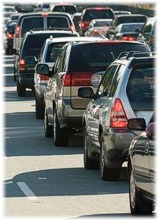
San Diego traffic reports show that we spend an average of 56 hours per year sitting in rush hour traffic . . . an average cost of $912 per year per driver. In a recent study of traffic congestion in urban areas, San Diego ranked as the 40th most impacted city in the country when it comes to traffic congestion.
 Click here for San Diego traffic accident information. Click here for San Diego traffic accident information.
How to avoid San Diego traffic congestion
With all the San Diego County highways and major arteries, you can always find optional routes to reach your destination. The best way to get the upper hand on traffic congestion is to view this San Diego traffic report before you get into your vehicle. Here you can see the latest San Diego traffic report, the average speed of traffic on your route, the location of traffic congestion and accidents, as well as the average traffic speed on alternate routes.
Many San Diegans work from home
The Census Bureau says there are about 1.5 million workers in San Diego County. 18.6% worked from home in 2022 . . . down from 22.1% in 2021. Overall, 15.2% of the U.S. workforce did so from home.
Most San Diego workers drive to work
Of those San Diego workers who commute, 68.9% drive alone . . . 8.2% carpool . . . 3.3% use mass transit . . . 0.7% bicycle . . . 3.2% walk. This means that San Diego traffic conditions can get really hectic during the prime commuting hours. Here's how it stacks up. 10% of San Diego workers leave for work between 5 and 6 a.m. - 21% between 6 and 7 a.m. - 25% between 7 and 8 a.m. - 17% between 8 and 9 a.m. - and the balance at other hours.
How much time do workers spend in San Diego traffic?
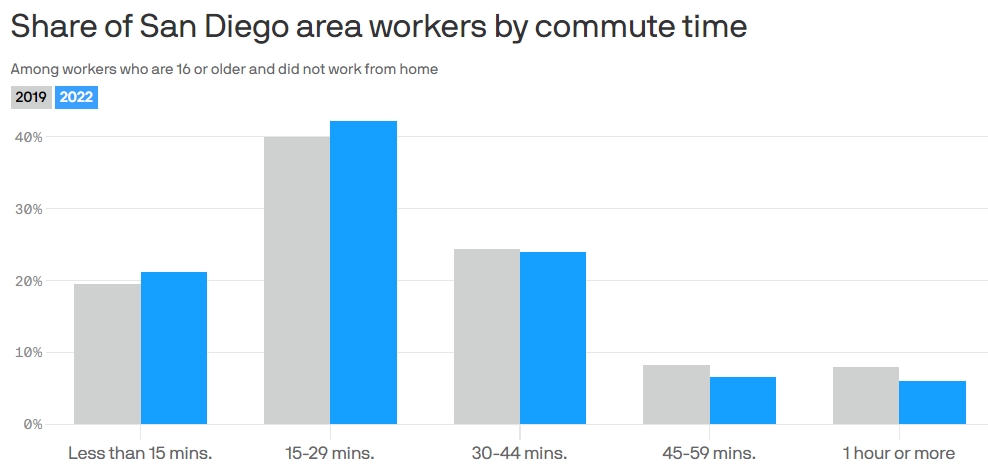
For more than two out of three commuters, getting to work takes less than half an hour. 1.7% drive 90 minutes or more . . . 3.6% drive 60 to 89 minutes . . . 5.7% drive 45 to 59 minutes . . . 3.4% take 40 to 44 minutes to commute . . . 2.9% have a commute time of 35 to 39 minutes . . . 14.6% take 30 - 34 minutes . . . 8% take 25 - 29 minutes . . . 19.5% commute for 20 - 24 minutes . . . 19.4% take 15 - 19 minutes to their work . . . 13.4% travel for 10 - 14 minutes . . . 6.5% have a commute time of 6 - 9 minutes and a lucky 1.3% take 5 minutes or less to get to work.
Live close to where you work
I always encourage my clients to buy a home near where they work. There are many fine neighborhoods throughout San Diego County and downtown is a bustling, thriving place to live. With the average cost of driving an automobile at .89 per mile, it may be wise to spend more for a home that's located near your work - not to mention the value of your time and peace of mind! Search data from the San Diego MLS to find a home located closer to your employment.
Remember public transportation
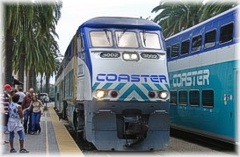
If you live near the coast, the SAN DIEGO COASTER is a fine alternative to sitting in San Diego traffic congestion on I-5. With convenient stops from downtown to the northern reaches of our county, you'll enjoy ocean and canyon views while doing business on your cell phone or laptop computer.
The COASTER is a popular alternative to driving for thousands of San Diegans. Ride the COASTER and you'll never have to worry about San Diego traffic reports, again! Click here for San Diego traffic accident information
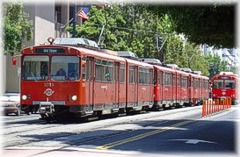
The SAN DIEGO TROLLEY is worth using if you travel around downtown San Diego and/or to and from the East County communities including SDSU. Expansion of the TROLLEY from Old Town to the UCSD campus and the UTC Shopping Center is complete and are now the busiest routes.
AMTRAK offers 11 daily trips between San Diego and Los Angeles. Also, it's another great alternative to driving from the coastal cities to downtown San Diego on the weekend.
And, don't forget the SPRINTER mass transit rail line runs 22 miles along the Highway 78 corridor. SPRINTER service includes 196 trains per day stopping at 15 convenient stations between Oceanside, Vista, San Marcos and Escondido including Palomar College.
SANDAG - Improving traffic conditions in San Diego
The San Diego Association of Governments (SANDAG), a regional planning group, is working with local, state and national agencies to improve San Diego traffic conditions. They manage the TransNet money . . . the half-cent sales tax dedicated to regional transportation improvements. TransNet has been the driving force for improving transportation in the San Diego region. The first 20-year TransNet measure was approved by voters in 1987. It went into effect in 1988 and was extended by voters in 2004 for an additional 40 years.
This program is one of the largest transportation improvement programs in California. TransNet funds numerous transit, highway, freight, bikeway, and walkway programs, in addition to an environmental conservation program, transit fare subsidies, and grants for smart growth, active transportation, and transportation services for seniors and persons with disabilities.
The initial 20-year TransNet program generated approximately $3.8 billion between 1988 and 2008. The TransNet extension has generated $4.4 billion to date and has been vital in helping to secure additional federal, state, and local funds. Working with partners Caltrans, MTS, and NCTD, SANDAG has delivered more than 700 projects for our communities. Highway Projects outlines new highway construction projects that will help improve San Diego traffic conditions.
New roads are not always the answer!
As promising as it is to think about new and wider highways, that may not be the best answer to San Diego's traffic problems. Studies indicate that widening highways is only a temporary solution to reducing traffic congestion. That's because new roads fill up soon after they open. A recent traffic report by U.C. Berkeley concluded that 90% of new highway capacity added to California's metropolitan areas is filled within four years, and 60 to 70% of all new county highways are filled within two years of completion.
The phenomenon known as "induced traffic," means that new and wider highways actually create additional traffic above and beyond what can be attributed to population increases and economic growth. Reports estimate that two-thirds of the growth in San Diego traffic in the coming decades, will be attributable to "induced" demand.
Build a highway and they will come
Studies of "Induced traffic" show that when additional roadway space is made available through highway widening or new road construction, drivers often abandon car pools and public transit. This creates additional trips and more San Diego traffic. Also, the more convenient access to expanded transportation routes encourages commuters to live further from work, fueling even more traffic demand. We've seen this most dramatically in the commute to downtown San Diego from Temecula on the I-15 and from Oceanside on the I-5.
What else causes San Diego traffic congestion?
San Diego housing is expensive, forcing people to move further out to find a place to live. The lack of affordable and mixed-income housing near job centers and the imbalance between jobs and housing, creates the notorious San Diego traffic reports of hour-long-plus commutes between places like Temecula and downtown San Diego. Click here for San Diego traffic accident information
Changes in San Diego school traffic patterns
In the 1950's more than half of San Diego school children walked or bicycled to school. That number has fallen below 10% as streets have become wider and more dangerous. This trend combined with the loss of school bus service, has resulted in an overwhelming increase in parents driving their children to and from school. San Diego traffic reports show that 20 to 25% of rush hour traffic on local streets is now attributable to the school commute.
Cell phones add to San Diego traffic congestion
Motorists talking on cell phones and texting messages crawl about 2 mph slower than drivers not on the phone. If you commute in San Diego traffic for an hour per day, this can add about 20 hours per year to your drive time. The National Academy of Sciences study found that drivers on cell phones tend to get behind slow drivers and they change lanes 20% less than drivers not on the phone. Overall, cell phone drivers take about 3% longer to drive the same San Diego traffic-clogged route. Since as many as one in 10 drivers are on the phone, it can really add up.
|

Are you finally ready to buy a home in San Diego?
Click here to search San Diego homes for sale.
|
|


 Carlsbad, California 92008